Safe Trading in Pokémon GO: Avoiding Scams
Most Pokémon GO trades go smoothly, but trading with strangers online comes with a few risks: people who want money, people who want your login, and people who promise a trade and never deliver. The good news is that the game itself makes the trade part hard to cheat, so the risks are mostly in what happens around the trade rather than inside it.
This guide explains what the official rules say, which requests are red flags, how to spot the common crowned Zacian and Zamazenta scam, how to check a trainer before you trade, and what to do if something goes wrong. The advice on spotting scams is PGT's own and is labelled as advice, not as a rule. Every source is listed at the bottom of the page.
Why the trade itself is hard to cheat
In the game, both trainers choose a Pokémon and both must confirm before the trade completes. Each trainer sees the Pokémon being offered, with its CP and HP shown as a range, and the Stardust cost beside the Confirm button. There is no step where one trainer sends first and hopes the other follows. If the Pokémon on the screen is not the one you agreed to, press Cancel.
Two rules also work in your favour. A Pokémon that has already been traded once cannot be traded again, and Mythical Pokémon cannot be traded at all. That means nobody can legitimately ask you to trade a Pokémon back after you have checked it, and nobody can trade you a Mythical Pokémon. See the remote trading guide for the full list of what can and cannot be traded.
What the official rules say
The terms of service say that Pokémon and other items in the game have no monetary value. They may be traded with other players for other game items, and they can never be sold, transferred or exchanged for money, goods, services or any other consideration. A violation, or an attempt, can lead to termination of your account.
- Do not buy, sell or trade accounts, and do not share them. The terms list both as cheating, and the player guidelines say the same about buying and selling accounts, currency or items on third-party platforms.
- Never give anyone your login. Niantic and Scopely never ask for your login details, not even from support, and an offer of free currency in exchange for them is always fake.
- Do not post other players' personal details, such as a name, phone number, email or address, without their consent.
- Use only the official app. Unauthorized apps risk a permanent ban.
Enforcement is graded. A first strike is a warning of about seven days with a degraded experience that can include being unable to trade or send Gifts, a second is a suspension of about 30 days, and a third is a permanent ban. Some behavior can be penalized immediately.
Red flags: PGT's advice
These are patterns that should make you stop. They are PGT's advice, not rules from Niantic, and a single one does not prove that someone is dishonest. Several together usually do.
- Anyone who asks for money, gift cards, cryptocurrency or any payment for a Pokémon. Selling Pokémon is against the terms above, and PGT is free to use.
- Anyone who asks for your login, a verification code or your Google, Apple or Facebook details. Real trading never needs them.
- An offer to sell or buy an account, or to hand over a high-level account. The terms forbid it, and a purchased account has no guarantees and gets no support.
- A request to trade a Pokémon back after you have looked at it, or to pass a Pokémon on to someone else. A traded Pokémon cannot be traded again, so this is either a mistake or a trick.
- A promise to send something later after you have sent yours. Trades in the game happen at the same moment for both of you, so there is no reason to go first.
- A claim that a Zacian or Zamazenta is "already crowned" so the crown is free for you. See the next section.
- A new account with no history, no reviews and no friends in your communities, asking for something valuable.
How to tell if a Zacian or Zamazenta has been crowned
This is a very common scam. Crowned Sword Zacian and Crowned Shield Zamazenta cannot be traded or transferred to Pokémon HOME while they are in their crowned forms, so a crowned Pokémon can never appear on the trade screen. What changes hands is the Hero of Many Battles form, and that is where the scam happens. The trade screen does show whether that Pokémon has been crowned before, as the checks below explain.
- Turning a Hero of Many Battles Zacian or Zamazenta into its crowned form costs 1,000 Crowned Sword Energy or Crowned Shield Energy, and the Pokémon must know the Charged Attack Iron Head.
- Once a trainer has changed a Zacian or Zamazenta's form once, that trainer can switch it between the two forms as often as they like without spending any more energy.
- A Zacian or Zamazenta that has been form changed before can be switched back to Hero of Many Battles, traded, and then crowned again by the new owner at no energy cost. A Zacian or Zamazenta that was never form changed costs the new owner the full 1,000 energy.
The scam is a seller who says "I crowned it, so it will be free for you" and then sends one that was never crowned. You are left needing 1,000 energy for a Pokémon you were told was ready. Some sellers add a payment, a Lucky Trinket or a request for your trainer code to the offer, which are red flags of their own.
Do not take anyone's word for it. The trade screen shows you what you need to know, and you can confirm it with a demonstration. Before you agree to the trade:
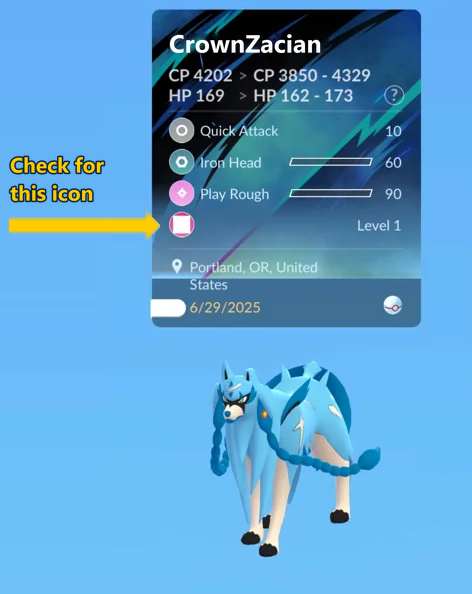
- Look at the Pokémon on the trade screen, under its CP and HP. A Zacian or Zamazenta that has been crowned before shows an extra row below its three moves, with its own round icon and a level next to it, such as Level 1. That row is the Max Move slot. If the row is missing, the Pokémon has not been crowned before and crowning it will cost you the full 1,000 energy, so treat the claim as false.
- Ask the trainer to show you on that exact Pokémon, with a video call or a screen recording of the game, the form change to Crowned and back to Hero of Many Battles. Only a Pokémon that has been form changed before can switch without energy, so a live switch of the Pokémon you will receive proves it.
- Keep your eyes on that Pokémon. The trade screen must show the same Zacian or Zamazenta, with the same CP range and the same appearance, as the one in the demonstration. Cancel if the trainer offers a different one.
- Never pay money, send a Lucky Trinket or give out your login to get a crowned Pokémon. Offers like that are scams, and selling Pokémon is against the terms.
- Check the trainer's reputation on PGT before you trade, and trade with someone you know when the Pokémon matters this much.
If you are scammed, report the trainer with the steps in the section below.
Check a trainer before you trade
PGT has four tools for this, all free and all visible before you send an offer.
- Reputation: every profile shows Completed Trades, Kudos and Trust. A trade only counts as completed once both trainers confirm it, and Trust is the average of the fairness, responsiveness and kindness scores trainers gave each other in reviews. Kudos reflect how active someone is in the community, not that they are perfect.
- Reviews: after a completed trade each trainer can rate the other on fairness, responsiveness and kindness, and the resulting Trust score is public on the profile.
- Verified Pokémon: rare Pokémon can carry a badge on a trainer's profile after the PGT team reviewed a short proof video of the trainer's account. The video is only available to the PGT team.
- The list of known scammers, a searchable public list. Check a name or social handle there before you trade with someone new.
Reputation shows that someone has traded fairly before. A new trainer with no history is not a scammer, so trade low-risk Pokémon first and build up. The friendship level you have in the game works the same way: a Best Friend you have traded with before is a better bet than a stranger.
Protect your account and your privacy
- Use a unique password per service, and keep your login provider secure. If you think your account is compromised, change your password immediately and unlink any login method you do not recognize.
- Know what friends can see. Friends can see your profile information, and they may learn your approximate location when you send a Gift or trade. You can set yourself Offline and hide some profile information.
- Control who can find you. Your Trainer Code can be reset permanently with the refresh icon, and you can turn off friend invites from people who have you in their Contacts.
- Remove friends you no longer trade with. Removing a friend does not notify them, and you can add them again later.
- When you meet in person, follow the usual advice for meeting people from the internet: a public place, daylight and a friend if you can.
If something goes wrong
- Stop. Do not send anything else, and do not give out any login detail. If you think your account is at risk, change your password straight away.
- Save the evidence: screenshots of the conversation, the trainer name, their Trainer Code and anything they sent.
- Report the trainer in the game through in-app support. The report keeps you anonymous, is reviewed as soon as possible, and warnings are generally tried first.
- Report them on PGT as well. Use the Report button in a conversation, on an offer or on their profile, or Report a Scammer on the Scammers page for someone you never spoke to. You must be signed in, reports cannot be anonymous, every report needs at least one piece of proof, and moderators review every report before anything happens. Reports that turn out to be false carry penalties for the person who filed them.
- Remove the person from your friends. They are not told.
Trades cannot be undone, and a traded Pokémon cannot be traded back, so prevention matters more than any remedy. We found no official process for restoring a Pokémon that was traded away.
Trading etiquette
- Agree exactly which Pokémon each of you will send before you meet, and check the confirm screen against it.
- Be upfront if you need to cancel. PGT flags trainers who repeatedly abandon confirmed trades or who waste another trainer's Lucky Trinket, and an account can be suspended for it.
- For a Remote Trade, allow for time zones. Each step has 48 hours to answer, so reply within the day.
- Say thank you and leave a review. It is the main way the next trainer knows you are reliable.
- Never pressure someone to trade, and never harass anyone who says no.
Ready to start? Read the Trade FAQ for how offers work, or create a free profile and send your first offer from the Trade page. New to trading? Start with trade evolution and Lucky Pokémon to decide what to trade for.
Quick answers
How can you tell if a Zacian or Zamazenta has been crowned?
Look at the trade screen. A Zacian or Zamazenta that has been crowned before shows an extra row below its three moves, with its own round icon and a level such as Level 1. If that row is missing, it has not been crowned before and crowning it costs the full 1,000 energy. A seller's claim proves nothing, so you can also ask them to show it switching between forms on a video call or screen recording, and never pay for it.
Can you trade a Crowned Sword Zacian or Crowned Shield Zamazenta?
No. While they are in their crowned forms they cannot be traded or transferred to Pokémon HOME. A trainer has to switch the Pokémon back to Hero of Many Battles first, and the new owner can then crown it again without energy only if it was crowned before.
How much energy does it cost to crown a Zacian or Zamazenta?
1,000 Crowned Sword Energy for Zacian or 1,000 Crowned Shield Energy for Zamazenta, and the Pokémon must know the Charged Attack Iron Head. After the first change, it can switch forms for free.
Can you get banned for selling a Pokémon for money?
Yes, it can lead to termination. The terms say Pokémon have no monetary value and can never be sold or exchanged for money, goods or services, and a violation or an attempt can end your account.
Is it safe to share my friend code?
It is a normal part of the game, and a request has to be accepted before anyone becomes your friend. Friends can see your profile information and may learn your approximate location when you send a Gift or trade, so only accept people you want to trade with. You can reset your Trainer Code at any time and turn off invites from your Contacts.
Can someone steal a Pokémon during an in-game trade?
No. Both trainers see the Pokémon and must confirm before the trade completes, so cancel if the screen does not match what you agreed. The risk is in what happens around the trade: payments, login requests and promises to send something later.
Why does someone want me to trade a Pokémon back?
It cannot be done. A Pokémon that has already been traded once cannot be traded again, so any request to trade back after checking is a mistake or a trick.
How do I report a scammer?
Report them in the game through in-app support, where you stay anonymous, and on PGT with the Report button or the Report a Scammer form on the Scammers page. Every PGT report needs at least one piece of proof, and moderators review every report.
Should I buy or sell a Pokémon account?
No. The terms forbid buying, selling, trading and sharing accounts, and a purchased account has no guarantees and gets no support.
Sources
PGT is independent from Pokémon GO. Scopely and Niantic can change these rules at any time. The rules above come from their published terms, Help Center and announcements. The red flags, the crowned Zacian and Zamazenta checks and the etiquette are PGT's own advice and are not part of those rules.
- Terms of Service (Scopely Explore) (official)
- Player Guidelines (Scopely Explore) (official)
- Keeping your account secure (Pokémon GO Help Center) (official)
- Trading Pokémon (Pokémon GO Help Center) (official)
- Adding friends (Pokémon GO Help Center) (official)
- Controlling your experience in Pokémon GO (Pokémon GO Help Center) (official)
- How can I report someone? (Pokémon GO Help Center) (official)
- What happens when I report someone? (Pokémon GO Help Center) (official)
- Gameplay Fairness Policy (Pokémon GO Help Center) (official)
- Unleash the power of Zacian and Zamazenta with new Crowned Sword and Crowned Shield Energy! (Pokémon GO, May 15, 2025) (official)
- Zacian (Pokémon GO Wiki, community wiki) (community)